02 Jul 2026
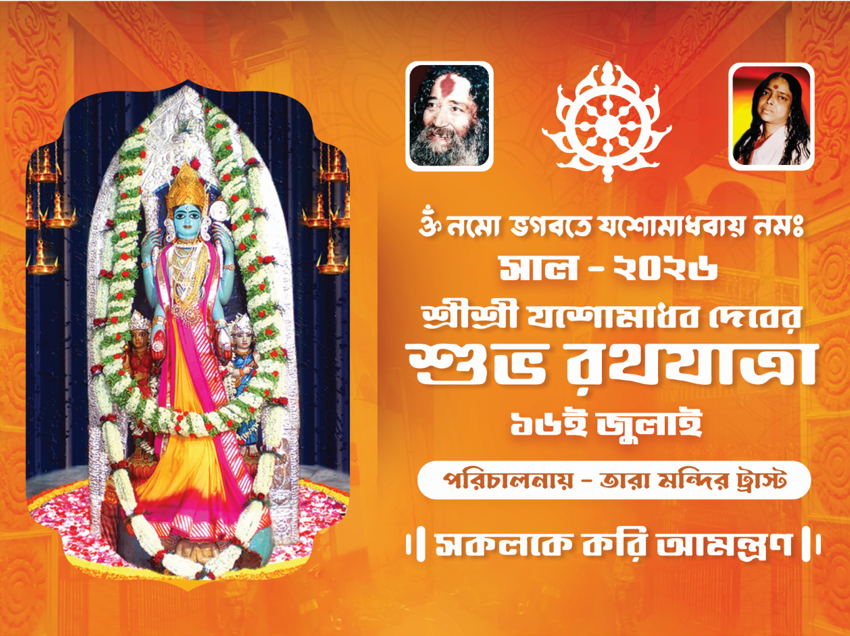
Sri Sri Yasho Madhav Deva’s Rath Yatra
Om Namo Bhagavate Yasho Madhavaya Namah
(Bengali year 1433 – Gregorian year 2026)
-------------------------------------------------------------------------------------------------------------------
If you stand quietly for a moment in Tarashankari Peeth, you can almost feel it. A story that began long before Kolkata, long before our time, still unfolding with every Rath Yatra. This is not just a festival on the calendar. It is a living memory of how the Lord chose to reveal Himself and how devotees have held on to that grace through joy, loss, and rebuilding.
How Yasho Madhav Revealed Himself
The journey of Sri Sri Yasho Madhav Dev starts in Dhamrai, near Dhaka. In those days, the last king of the Pala dynasty, Raja Yashopal, was riding on his royal elephant, passing through the countryside. Everything was as usual until, suddenly, the elephant stopped.
It halted in front of a small, unremarkable mound of earth and refused to move. The king tried to press on, but the animal simply would not step forward. Sensing something beyond ordinary stubbornness, Raja Yashopal ordered his men to dig at that spot.
As the soil was cleared away, the workers uncovered a sacred idol of Lord Vishnu, along with the beautiful sculpture of Madhav. What looked like a simple mound turned out to be a hidden altar.
Dhamrai’s learned scholar, Sri Ramjiban Ray, carefully restored the idol and performed the necessary rites. And in gratitude to the king whose journey had led to this discovery, he named the deity ‘Sri Sri Yasho Madhav’, after Raja Yashopal.
From the year 1079 in the Bengali calendar, Yasho Madhav was established in Dhamrai, and from then on, the Rath Yatra of the Lord has been celebrated there. For centuries, generation after generation has watched the same chariot move along the same paths, carrying the same Lord whose presence was revealed from that quiet mound of earth.
War, Loss, And the Devotees’ Answer
In 1971, during the Liberation War, the Dhamrai temple faced a devastating blow. The Pakistani army desecrated the original Yasho Madhav idol and set fire to the historic rath that had carried Him through the streets for hundreds of years. For the devotees, it was not just wood and metal that burned. A visible symbol of their faith had been shattered.
Yet, faith is stubborn in the best way. With the support of the Indian High Commission and the steady resolve of the community, the idol was restored and the chariot rebuilt. Out of ashes and broken stone, the devotees rebuilt what mattered to them most, the holy chariot to carry their Lord through the world.
How Yasho Madhav Came to Kolkata
The story then crosses borders and time to Kolkata, to the Shyambazar–Belgachia area. There stands Tarashankari Peeth, founded by Yogi Maharaj Sri Sri Paresh Chandra Ray Maulik, a direct descendant of the same Sri Ramjiban Ray of Dhamrai.
His family had settled in Kolkata even before Independence. But the connection to Dhamrai and to Yasho Madhav remained alive in memory and lineage. Guided by a strong inner call and daiva adesh, Yogi Maharaj and his devoted wife, Yogamata Srimati Anjali Ray Maulik, decided that the Lord should be present here.
With deep devotion, they undertook a remarkable vow: to offer one crore (10 Million) tulsi leaves, each sanctified with mantra, to the Lord. It was their way of preparing a place not just in stone, but in their own hearts and in the hearts of the devotees.
On the sacred day of Maghi Purnima in 1978, after this intense offering, the idol of Sri Sri Yasho Madhav was installed at Tarashankari Peeth. Beside Him stand Devi Lakshmi and Devi Saraswati, flanked by Kanai and Balai.
From that day, Kolkata too became part of Yasho Madhav’s story.
The One Day When Devotees Touch His Feet
There is one privilege that makes this Rath Yatra especially dear to devotees. All year long, they offer flowers, prayers, and silent wishes from a respectful distance. But only on the day of Rath Yatra do they receive the rare blessing of touching the lotus feet of the Lord.
For many, that single moment carries the weight of the whole year; a chance to place their worries, gratitude, and unspoken prayers right at His feet. People wait patiently, move carefully, and you can see on their faces that something inside them becomes lighter as they bow down.
Every year, the chariot of Yasho Madhav sets out from Tarashankari Peeth and travels to Madhab Bari in Hatibagan, opposite Star Theatre. The route may be mapped on a city chart, but for the devotees, it feels like watching the Lord step out into their everyday world, blessing each lane and each crossroad as He passes.
A City Wrapped in Devotion
When the rath begins to move, the streets take on a different character. The crowd is a mix of neighbourhood residents, long‑time devotees, curious visitors, elders, children, and youth. Some pull the ropes with visible energy. Others walk more quietly, taking in the sound and movement around them.
Traditional instruments and kirtan fills the air, sometimes loud and jubilant, sometimes softer and more reflective. For many participants, simply walking behind the chariot, listening to the chanting, becomes a form of prayer.
Police and civic authorities manage traffic and safety; local leaders and media often lend presence and support. Yet the essence of the event lies in the ordinary people who choose to walk, sing, or even just stand with folded hands as the chariot passes.
On the ropes of the rath, social labels lose their sharpness. Different economic backgrounds, occupations and communities stand shoulder to shoulder. This visible sense of equality and shared purpose is the quiet essence of Rath Yatra.
Nine Days at Madhab Bari, Hatibagan
This year, on 16 July, the sequence will follow a familiar and carefully maintained pattern. From 3 p.m., after welcoming rituals inside the temple are completed, the idol of Sri Yasho Madhav will be placed on the chariot. At around 3:30 p.m., the formal inauguration will be conducted, and then the Rath Yatra will begin.
After travelling via different roads, the chariot will reach Madhab Bari in Hatibagan, opposite Star Theatre. The family of the founder, Sri Madhusudan Ray, still resides there and continues to receive Sri Yasho Madhav with the same reverence and care that has been shown for decades. The arrival is treated as an honour and a responsibility.
For the following nine days, Madhab Bari becomes the center of intense devotional activity. Daily worship and arti are performed with attention and care. Offerings are prepared according to tradition. Kirtan and devotional music extend into the evenings. Religious discourses, storytelling and various forms of seva for guests and devotees take place throughout this period.
Devotees come in large numbers for darshan. All have the chance to receive the holy prasad.
The Return Journey to Tarashankari Peeth
At the end of nine days, the focus shifts again. Sri Yasho Madhav prepares to return to Tarashankari Peeth. On the day known as Ulto Rath, the “return chariot,” which falls on 24 July this year, the idol will once more be placed on the rath.
A similar procession, with music, chanting and participation from devotees, accompanies the Lord back to His original seat at Belgachia. The cycle of departure and return becomes part of how devotees mark time and continuity.
The Rath Yatra of Yasho Madhav Deva carries forward the divine legacy from the chariot festival of Dhamrai which is hundreds of years old now. The Lord’s annual visit to Madhab Bari continues without interruption till date. Changes in the city, in transport, and in daily life have not interrupted the core ssence of the festival.
The Custodians of a Living Tradition
At present, Tarashankari Peeth in Belgachia is managed by the Taramandir Trust. The Trust carries the formal responsibility for organising the Rath Yatra and related arrangements. This includes coordinating rituals, logistics, routes, safety measures, and communication with civic authorities.
Through this work, they help ensure that what began in Dhamrai centuries ago and took new form in Kolkata in the late 20th century, continues as a living, accessible tradition.
Joi Guru. Joi Yasho Madhav.